
The Coherence Economy
Repatterning our economies in greater service to life


This essay is a synthesis of decades of professional experience, lived inquiry and continual learning. It is intentionally incomplete and imperfect; a life’s work still unfolding.
Perhaps coherence itself invites participation over perfection.
So rather than waiting for certainty, I have chosen to share these reflections now, in the hope of contributing to a larger conversation that is already emerging around us.
I started writing this piece several months ago, before finding myself on a hiatus from writing as I explored parts of Peru, Bolivia, Costa Rica, Guatemala and Hawai’i (more on the travels to come); before returning to Australia after a twelve-month soul pilgrimage and vision quest for discovering more deeply who I am, where I come from and what may be emerging next.
As always, I am interested in what resonates, what challenges our thinking, and what actions might move us toward greater coherence together.
“When a complex system is far from equilibrium, small islands of coherence in a sea of chaos have the capacity to shift the entire system to a higher order.” — Ilya Prigogine
At university, I completed degrees in economics and commerce (majors in money & banking and accounting) with distinction averages and went onto practice as a Certified Practising Accountant (CPA).
I devoted myself to more than 20 years working within the financial system, primarily in banking, developing strategies to generate shareholder profits while protecting balance sheets and understanding how capital flows through our economy at scale.
Alongside this, I spent many years working with charities and social enterprises; organisations deeply committed to people, community, and our planet, yet often constrained by funding for their important work.
Positioned in both worlds, I began to notice a persistent tension.
On one side: systems with capital, scale, power and influence, however, often disconnected from lived human and ecological realities.
On the other: systems rich in purpose and care, yet structurally underpowered and ‘under-resourced’.
And somewhere between them, a question persisted in me:
Why are these systems, which are meant to be designed to support our lives… so often at odds with life itself?
This question has followed me across contexts and countries and deepened through experiences such as walking the Camino de Santiago across Spain last year and recently living in Central America.
What I’ve come to see is this:
The challenge is certainly not a lack of intelligence, capability, ideas, innovation, solutions or intent.
It is a lack of coherence.
We inherited systems designed for a different time.
We are living through their consequences.
And we are being asked to design what comes next.
The Field Emerging...
The ideas being explored here are not necessarily new - they come from a long history of inquiry and are emergent in the collective field.
They sit within a growing body of work spanning systems thinking, ecology, economics, governance, complexity sciences, regenerative practices, deep listening in nature and teachings from Indigenous wisdom keepers - a collective inquiry that is challenging the mechanistic worldviews that has shaped much of the industrial era.
I was first introduced to systems thinking at an early age through my father, a mathematician and statistician, who encouraged me to question assumptions, think critically, and seek clarity before certainty. Looking back, I realise those conversations planted the seeds of a lifelong fascination with patterns, relationships, and the search for truth and meaning. In many ways, he was teaching me to seek coherence before conclusions - to remain with complexity until the deeper patterns began to emerge.
Beginning in the 1970s, thinkers such as Fritjof Capra and Donella Meadows helped lay the foundations of modern systems thinking, inviting us to see the world not as a collection of separate parts, but as networks of relationships, feedback loops, and living systems.
As Capra highlights:
“The basic pattern of life is a network.”
This marked an important shift - from viewing economies, organisations, and communities as machines to be optimised, toward understanding them as complex dynamic living systems capable of adaptation, emergence, and evolution.
In the decades that followed, sustainability thinkers began asking how human systems might operate within ecological limits. In 1994, John Elkington introduced the Triple Bottom Line, encouraging organisations to account not only for profit, but also for people and our planet.
Early in my professional career, as Treasury Accountant for a City Council, I worked on an initiative to embed triple line reporting into our Local Government reporting. I could see the huge potential value for this type of reporting and yet experienced the tensions of measuring the more ‘intangible’ social and environmental metrics to make this meaningful to affect change.
By 2018, Elkington himself issued a public “recall” of the framework, recognising that measurement alone had not produced the systemic transformation required.
Elkington later reflected:
“The success or failure of our economies is increasingly dependent on the success or failure of our ecosystems.”
Meanwhile, alternative economic paradigms continued to emerge.
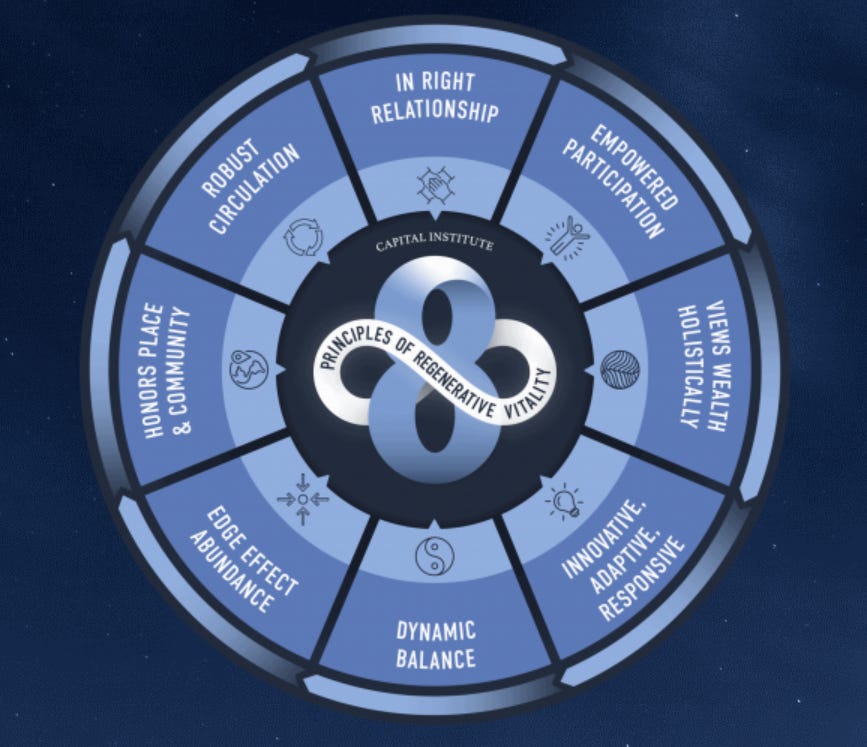
After leaving Wall Street in 2001, former JPMorgan Managing Director John Fullerton spent nearly a decade exploring what economics might look like if designed according to the principles that govern healthy living systems. Through the Capital Institute and his work on Regenerative Economics, he introduced 8 principles of regenerative vitality including Right Relationship, Empowered Participation, Holistic Wealth, Robust Circulation and the dynamic balance between efficiency and resilience.
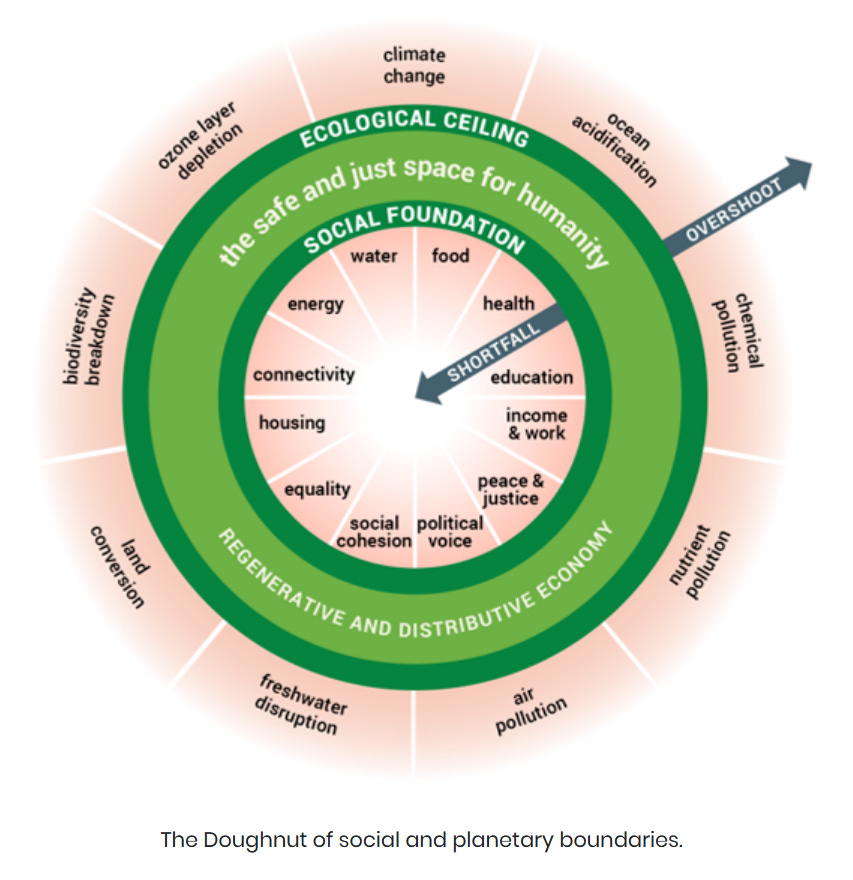
In 2012, Kate Raworth’s Doughnut Economics marked a significant shift in economic thinking by recognising that the economy is not separate from life, but exists within social and ecological systems. Her work challenged the assumption that economic growth alone is a sufficient measure of progress and instead asked how humanity might thrive within planetary boundaries.
At the level of governance, Elinor Ostrom demonstrated that communities could successfully manage shared resources through commons-based and polycentric systems - challenging assumptions that only markets or centralised institutions could coordinate complexity.
Building further on this web of insight, leaders such as Daniel Christian Wahl, Nora Bateson, Carol Sanford, Helena Norberg-Hodge, Professor Anne Poelina and Dr Lyla June Johnston have each continued to expand and deepen our understanding of regeneration, reciprocity, relationship, stewardship and the conditions that allow life to flourish. While each speaks to a unique perspective, they share a common insight: healthy human systems emerge from healthy relationships - with one another, with place, and with the living world.
Across Aboriginal and Torres Strait Islander Nations, Elders and knowledge holders have carried sophisticated ways of understanding the world grounded in respect, relationship, reciprocity, and responsibility to Country. Land, water, and community are not viewed as separate resources to be managed, but as living relationships to be respected and honoured. These enduring knowledge systems embody many of the relational principles explored throughout this article and remind us that such ways of knowing have been practised on this continent for tens of thousands of years.
Laura Storm’s work on Regenerative Leadership extends these ideas beyond economics and governance into the practice of leadership itself. Rather than seeking to manage or control complex systems, she invites leaders to cultivate the conditions in which life can renew, adapt, and flourish. In this view, leadership becomes less about directing change and more about stewarding the health, relationships, and regenerative capacity of the whole.
Across multiple disciplines, a similar pattern keeps emerging:
Economies are not separate from society.
Societies are not separate from ecology.
And living systems cannot be understood by isolating parts from the relationships that sustain them.
Permaculture, pioneered by Bill Mollison and David Holmgren in the 1970s, introduced a design philosophy grounded in observing natural systems and applying ecological principles to the creation of resilient human settlements. Since then, permaculture has flourished all over the world and we are now seeing the fruits and forests of these seeds planted more than 40 years ago.
Building on these foundations, Regenesis Group has advanced regenerative design & development through The Regenerative Practitioner (TRP) training, inviting practitioners to move beyond sustaining what exists toward revealing the unique potential of people, place, and living systems. Together, these approaches shift our attention from managing resources to participating in the continual evolution of life’s vitality.
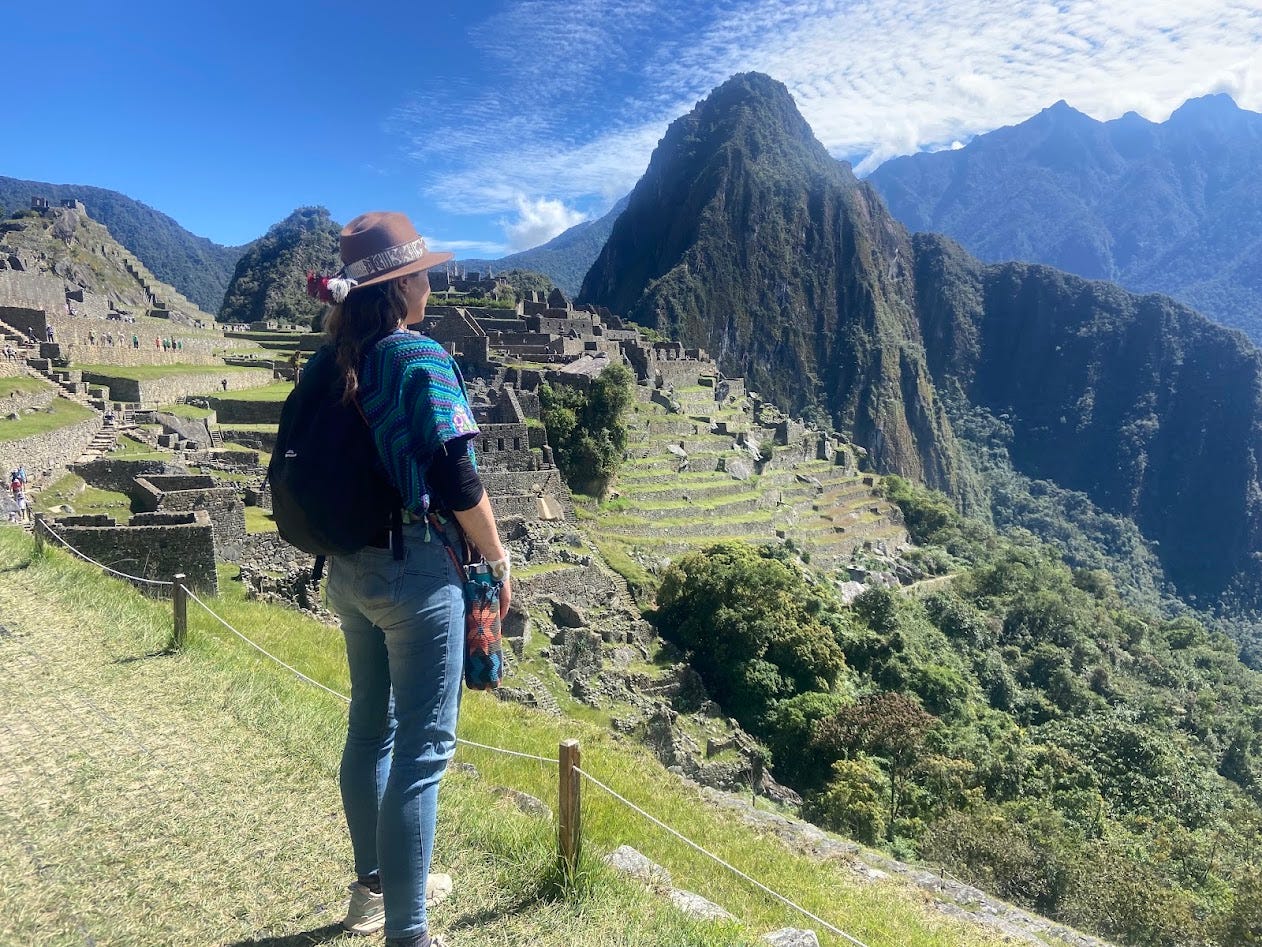
On my recent travels, when I arrived at Machu Picchu in Peru, I was struck not only by the sophistication of its engineering, but by the coherence of its design. Water, agriculture, astronomy, architecture, landscape, community, and culture were not conceived as separate systems to be optimised independently, but as interconnected expressions of a larger whole.
It left me wondering whether one of humanity’s oldest forms of intelligence was never simply our ability to build complex systems, but our ability to perceive the interconnected relationships between them.
Perhaps coherence is less about invention than remembrance.
Not a new human technology, but an ancient pattern of life organising life that we are rediscovering again and again in new ways, when we are quiet enough to listen.
What Is Still Missing?
Despite this growing body of insight, something is still not landing into the physical world.
We stand on the shoulders of giants with powerful contributions to the collective field.
Over the past fifty years, extraordinary advances have been made across systems thinking, regenerative economics, technology, governance, leadership, and living systems science. Collectively, these fields have transformed our understanding of how healthy systems function and are regularly observed as patterns already inherent in Indigenous knowledge systems and the natural world.
Yet the outcomes we seek today remain frustratingly elusive.
We still see:
economic systems that concentrate wealth while eroding social and ecological resilience;
regenerative initiatives funded by capital models that reward extraction over stewardship;
decentralised organisations that quietly recreate centralised power;
purpose-led organisations unable to sustain themselves or the people leading them;
leaders with inspiring visions operating in cycles of exhaustion rather than renewal.
The question is no longer whether we have enough ideas.
The question is why so many great ideas remain fragmented, unable to realise their collective potential.
We have become increasingly sophisticated at measuring impact, developing governance models, designing institutions, and optimising individual parts. What we continue to struggle with is aligning those parts into a coherent whole.
As Nora Bateson reminds us:
“The world is not made up of things. It is made up of relationships.”
Perhaps the next evolution is therefore not another model to add to the growing collection of frameworks, but a way of bringing them into the right relationship with one another.
This essay proposes that coherence may be the practical expression of that principle.
It is not presented here as another framework, certification or metric.
But a lens through which existing ideas can be aligned, integrated and translated into everyday decisions.
This becomes particularly important when we consider capital itself.
Even many regenerative initiatives remain financed through investment models that reward short-term returns, perpetual growth and liquidity ahead of long-term stewardship. While these structures can mobilise capital efficiently, they also shape behaviour. The logic of extraction inevitably influences the systems it funds.
Capital does not simply finance systems.
Capital shapes systems.
Unless the logic of capital evolves, even our most well-intentioned efforts risk reproducing the very patterns they seek to transform.
Rupert Faust’s Eleven Forms of Capital, building on Ethan Roland and Gregory Landua’s Eight Forms of Capital, reminds us that financial capital is only one expression of wealth. Relationships, knowledge, living systems, trust, cultural wisdom, meaning and social connection are equally essential to the vitality and resilience of communities.
From a coherence perspective, prosperity is not created by maximising any single form of capital.
It emerges through the healthy circulation and reciprocity between them.
This points toward a deeper shift.
For centuries, economics has largely measured what is visible - extracted materials, physical production, transactions, outputs, productivity and growth.
Yet many of the forces that determine whether systems flourish remain largely invisible.
This includes trust, belonging, culture, purpose, reciprocity and meaning.
The visible economy emerges from these less visible structures.
I believe coherence is the missing bridge between them.
Where relationships, incentives, governance, capital and consciousness become aligned in service of life as a living whole.
Technology: Amplifier or Distorter?
At the same time, we are rapidly building the infrastructure of the next economy.
Artificial intelligence, blockchain, and decentralised technologies are transforming how we see, coordinate and exchange value.
In many ways, they enable what regenerative thinkers have long envisioned:
decentralisation
transparency
new forms of coordination
And yet, we are already seeing familiar patterns re-emerge:
impact initiatives optimising for reporting rather than true transformation.
decentralised structures replicating centralised power.
digital platforms optimising for engagement rather than genuine connection.
AI reinforcing existing biases, assumptions and incentive structures.
technologies promising empowerment while reinforcing dependency.
The issue is not the technology itself.
Technology is an amplifier.
It magnifies the coherence - or incoherence - of the people, organisations and systems that create and use it.
“We shape our tools and thereafter our tools shape us.”
— Marshall McLuhan
Power, Governance, and Design
It is also important to acknowledge that incoherence is not always accidental.
It is often structurally embedded.
Incentives reward short-term gains.
Capital concentrates power.
Governance structures can disconnect decision-makers from the impact of their decisions.
In coherent systems, the way decisions are made in the smallest unit reflects how they are made in the whole. Without this, systems tend to fragment or re-centralise as they grow. Fractal governance offers a pathway to scale without losing integrity.
Emerging approaches such as fractal governance point to a further evolution; where governance is not only distributed, but patterned consistently across scales.
“Fractally“ is helping to power the next-generation Decentralized Autonomous Organizations (DAOs), which uses “Respect” as a currency to reward community contributions through consensus.
Respect is the foundation of relational coherence - without it, even the most well-designed systems will struggle to hold alignment.
Furthermore, Holistic decision-making considers the long-term health of the whole system - integrating ecological, social, and economic impacts rather than optimising for any single outcome.
As Elinor Ostrom demonstrated, alternative governance models are possible but they must be intentionally designed.
And as Mariana Mazzucato argues, economies can be oriented toward shared missions but only when institutions are aligned to support them.
Without redesigning power and incentives, coherence cannot emerge at scale.
So, What Is Coherence?
Coherence is the quality of forming a unified whole.
It is a quality that allows systems to hold tension without breaking.
It is the alignment of people, relationships, structures, capital, and ecology in a way that allows life to flow and systems to function over time.
Coherence does not emerge from individual or organisational excellence alone. It emerges through the quality of relationships between parts. Whether within a person, a team, an organisation, a bioregion, or an economy, coherence arises when relationships, incentives, and flows become aligned in service to life as the ‘greater whole’.
A coherent system is characterised by clarity of purpose, relational integrity, and alignment between what it values and how it operates. It is responsive to feedback, able to hold tension without fragmentation, and structured in ways that reinforce trust, reciprocity, and long-term wellbeing.
Across scales, coherence emerges where patterns are consistent, intelligence is distributed, and decisions are made with awareness of their wider impact - allowing the whole system to function, adapt, and evolve over time.
These coherent qualities apply fractally and in relational symbiosis, between Individual, Relational Connections, Projects & Organisations, Bioregions & Ecological Systems and the Greater Whole.
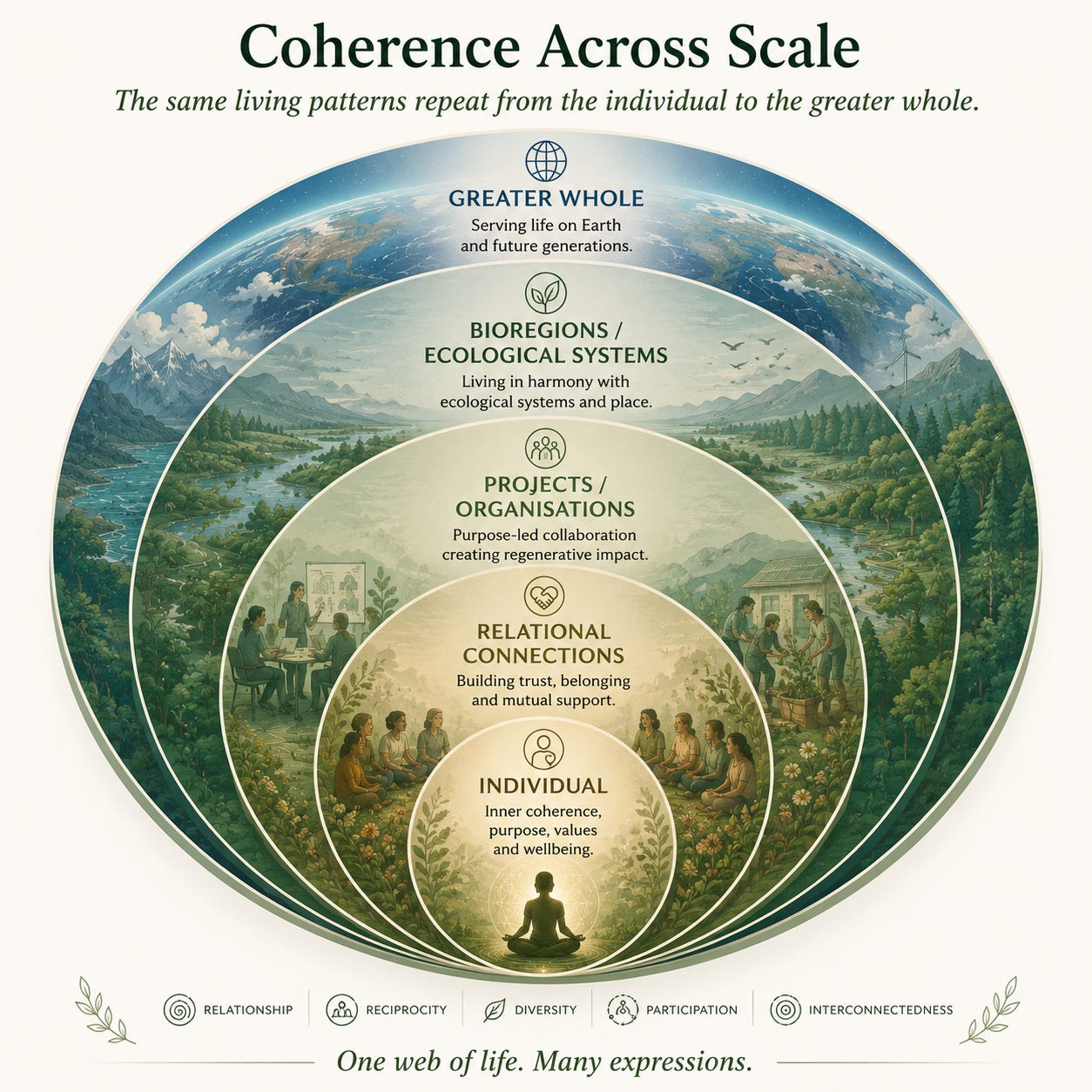
This illustration is intentionally simplified. Living systems are neither linear nor hierarchical, but dynamic, nested and deeply interconnected. While shown here as concentric scales for clarity, influence flows in every direction, with each part continuously shaping and being shaped by the others.
Any healthy living system continually balances complementary polarities (e.g. breathing requires both inhale and exhale) rather than optimising for one at the expense of another.
Coherence is not equilibrium. It is the dynamic capacity of a living system to balance seemingly opposing yet complementary qualities in response to changing conditions.
So, if coherence offers a lens for seeing the quality of relationships within living systems, the question then becomes: how might this quality be better translated into practice?
One response comes through the work of Regenesis, which teaches practical frameworks and methods for regenerative development and design. Through practices such as Story of Place and Potential-Based Design, it seeks not simply to solve problems, but to reveal the unique potential of a place and strengthen the relationships that enable its continued evolution. Rather than treating projects as isolated interventions, they become catalysts for the ongoing vitality of people, communities and the living systems they inhabit.
While every living system may express coherence in its own unique way, certain qualities consistently emerge. The acronym COHERENCE is offered as a simple synthesis of these recurring patterns and a practical way to recognise and cultivate coherence in practice.
C = Clear Purpose (Direction, long-term orientation, service to life)
O = Openness & Feedback (Listening, sensing, responsiveness)
H = Holistic Thinking (Whole-system decision making, contextual awareness)
E = Energy & Flow (Healthy circulation, minimal friction, promotes vitality)
R = Relational Integrity (Trust, reciprocity, transparency)
E = Evolving (Learning, adaption, renewal)
N = Nested Alignment (Fractal integrity across scales)
C = Capacity for Tension (Integrating paradox without fragmentation)
E = Embodied Resonance (Alignment that is lived and felt)
Cultivating for Inner and Outer Coherence
Coherence is not only an attribute of outer systems. It is also a quality of the human experience.
While much of this essay has focused on economic, organisational, and ecological systems, the same principles apply within ourselves. However, just as living systems co-evolve through relationships, so too do our inner lives and the systems we create. Inner and outer coherence are not separate pursuits, but mutually shaping expressions of the same living process.
Inner coherence emerges when our values, beliefs, intentions, actions, and relationships are aligned. It requires self-awareness, reflection, and the willingness to recognise where fear, scarcity, ego, disconnection or unconscious patterns may be shaping our decisions.
This is not about perfection. It is about integrity.
The quality of our external systems often reflects the quality of the relationships from which they emerge. An organisation operating from fear will struggle to cultivate trust. An economy shaped by chronic scarcity and separation will often reproduce those same conditions at scale.
Outer coherence and inner coherence exist in symbiosis. One reinforces the other.
Perhaps this is why many wisdom traditions, alongside modern developmental and systems thinking, begin with the same premise: meaningful change starts with awareness and deep listening. The work of creating more coherent systems is therefore not only structural and economic - it is relational, developmental, and deeply human.
What Incoherence Looks Like
Coherence is not just theory. It’s experiential.
We have all recognised incoherence in our lived experiences.
Incoherence might look like:
a founder with a powerful vision, but whose way of working is sustained by chronic overextension rather than the vitality needed to realise that vision.
a regenerative project dependent on extractive or unsustainable funding sources
a decentralised organisation with hidden power concentrations and decision-making bottlenecks.
a purpose-led business that creates immense value for others, but lacks the financial viability to sustain its own purpose.
institutions optimising for metrics or growth while losing alignment with their intended purpose within the context they are now in.
economic activity dependent on degrading the ecological systems upon which it relies.
In each case, something is out of alignment.
Incoherence is not failure. It is feedback.
It is what we do with this feedback that matters, and this is where intervention and repatterning is needed.
Often we seek the path of least resistance, we default to what we already know perpetuating the same issues over a lifetime and in some cases for generations, not out of malice but because we don’t know any different - it takes individuals to be the circuit breaker for these patterns.
What if in those moments of decision, we can choose something different for ourselves and the collective, towards greater coherence?
We can see these dynamics clearly in global energy systems. Oil and energy markets underpin modern economies for transport and production, yet their increasing volatility reveals deeper structural misalignments. Systems designed for efficiency and short-term return are now exposing businesses and communities to instability, price shocks, and geopolitical risk. This is not simply a supply issue - it is a coherence issue. It reveals what happens when efficiency is prioritised over health and resilience, and when global dependency outpaces local capacity.
The way energy is produced, financed, and distributed is not aligned with the ecological, economic, and social realities it operates within. A more coherent approach would prioritise resilience, localisation, and long-term stability - aligning energy systems with the conditions that allow them to endure.
Where Change Actually Happens
As Donella Meadows observed:
“A small shift in one thing can produce big changes in everything.”
The challenge is knowing where to intervene.
Coherence provides a way of seeing this.
Change happens across scales:
how individuals relate to value and money
how people relate to each other
how systems are structured
how capital flows
how we relate to the living world
When these align, systems begin to function differently.
This is not merely theoretical. We see its effects every day - in our relationships, our organisations and the health of the places we inhabit.
Our current economic system is not only underperforming socially - it is destabilising the ecological and social systems it depends on.
The task ahead is not to replace our economic systems ‘top-down’, but to repattern them collectively and coherently, in service to life’s vitality.
What a Coherence Economy Might Look Like
A coherence economy is not a fixed model.
It is a direction.
We see early examples in:
bioregional and localised economic systems
investment approaches rewarding long-term stewardship alongside financial returns
new business models and regenerative approaches to land, capital and governance
organisations prioritising long-term wellbeing and purposeful impact for people and place
communities reclaiming stewardship of shared resources
products, services and infrastructure designed for circularity, durability and regenerative material flows
As Helena Norberg-Hodge demonstrates, localisation strengthens resilience and connection.
And as all Indigenous knowledge systems remind us, humans are not separate from the living world but participants within it.
A coherence economy would therefore be:
place-based
relational
adaptive
and developmental
It is not imposed - it is cultivated through respect, honesty, integrity, connection and trust.
The Invitation
Many of us sense that something is out of alignment.
We see it in our institutions, our communities, our relationships, and sometimes within ourselves.
We see it in rising levels of anxiety and loneliness alongside unprecedented connectivity. In ecological decline amidst extraordinary technological capability. In systems that generate immense wealth while leaving many people feeling exhausted, disconnected, displaced or unable to participate in the prosperity they help create.
Perhaps the question is not:
“How do we reshape the economies we participate in?”
But rather:
Where is incoherence present and what would it take to restore alignment?
Because the systems we build inevitably reflect the relationships, incentives, assumptions, and consciousness from which they emerge.
While coherence begins as a quality within individuals and relationships, it does not stop there.
Highly conscious and values-aligned people may still find themselves operating within institutions designed for entirely different outcomes. Equally, even the most elegant policies and governance structures will struggle to endure without the trust, maturity, and stewardship required to sustain them.
A coherence economy requires both inner development and the redesign of the rules, incentives, governance structures, ownership models, and capital flows that shape collective behaviour.
Perhaps the task before us is not to dismantle everything built so far, nor to cling to the systems that no longer serve, but to consciously repattern what we are already sensing - integrating the wisdom of the past with the possibilities of the future in service of life.
Every decision we make today becomes part of the architecture of tomorrow’s economy.
The future is something we shape - through the qualities we bring to our thinking, our relationships, our leadership, our investments, our consumption, our organisations, how we live and the systems we choose to build together.
The invitation is simple:
Where are you noticing coherence emerging?
Where are you noticing incoherence asking for attention?
And what might become possible if we deeply listened to the pulse of life, creating the conditions for greater coherence to unfold in service of the vitality and flourishing of the greater whole?
“You never change things by fighting the existing reality. To change something, build a new model that makes the existing model obsolete.”
― Buckminster Fuller
Acknowledgement
This essay is a synthesis of ideas that have emerged over many years of inquiry, conversation, teaching, research, deep listening and lived experience. It is both an integration of these influences and a contribution to an ongoing, emerging conversation.
I offer my deep respect to Aboriginal and Torres Strait Islander Peoples of Australia, whose diverse and enduring knowledge systems continue to illuminate ways of living in right relationship with Country, community and the greater whole.
This work is offered in the spirit of learning, synthesis and ongoing dialogue.
References
Bateson, N. (2016). Small arcs of larger circles: Framing through other patterns. Triarchy Press.
Capra, F. (1996). The web of life: A new scientific understanding of living systems. Anchor Books.
Elkington, J. (1997). Cannibals with forks: The triple bottom line of 21st century business. Capstone.
Elkington, J. (2018). 25 years ago I coined the phrase “Triple Bottom Line.” Here’s why it’s time to rethink it. Harvard Business Review. https://hbr.org/2018/06/25-years-ago-i-coined-the-phrase-triple-bottom-line-heres-why-im-giving-up-on-it
Fullerton, J. (2015). Regenerative capitalism: How universal principles and patterns will shape our new economy. Capital Institute.
Holmgren, D. (2002). Permaculture: Principles and pathways beyond sustainability. Holmgren Design Services.
Landua, G., Roland, E., & others. (2016). The eight forms of capital. AppleSeed Permaculture.
Mang, P., & Haggard, B. (2016). Regenerative development and design: A framework for evolving sustainability. Wiley.
Mazzucato, M. (2021). Mission economy: A moonshot guide to changing capitalism. Allen Lane.
Meadows, D. H. (2008). Thinking in systems: A primer. Chelsea Green Publishing.
Mollison, B. (1988). Permaculture: A designer’s manual. Tagari Publications.
Norberg-Hodge, H. (2019). Local is our future: Steps to an economics of happiness. Local Futures.
Ostrom, E. (1990). Governing the commons: The evolution of institutions for collective action. Cambridge University Press.
Prigogine, I., & Stengers, I. (1984). Order out of chaos: Man’s new dialogue with nature. Bantam Books.
Raworth, K. (2017). Doughnut economics: Seven ways to think like a 21st-century economist. Chelsea Green Publishing.
Roland, E., & Landua, G. (2013). Regenerative enterprise: Optimizing for multi-capital abundance. Terra Genesis International.
Sanford, C. (2017). The regenerative business: Redesign work, cultivate human potential, achieve extraordinary outcomes. Nicholas Brealey.
Storm, L., & Hutchins, G. (2019). Regenerative leadership: The DNA of life-affirming 21st century organisations. Wordzworth Publishing.
Wahl, D. C. (2016). Designing regenerative cultures. Triarchy Press.
Thank you for reading
If you’ve made it this far, thank you.
This article is offered not as a conclusion, but as an invitation - a contribution to an emerging conversation about how we might repattern our lives, systems, organisations, economies and institutions in greater service to life’s vitality. It is a weaving together of many teachers, disciplines, cultures and lived experiences, interpreted through my own evolving reflections.
If these ideas resonated with you, I’d love to hear your thoughts. Every conversation helps refine the work, deepen the questions, and move us a little closer to the future we are collectively creating.
Through Haylo Consulting, I partner with organisations, communities and changemakers to translate regenerative thinking into practical action - helping design coherent strategies, governance, capital models, decision-making frameworks and systems that enable people and places to flourish.
Because coherence is not something we achieve alone.
It emerges through the quality of the relationships we build together.
Thank you for being part of this journey.
With love and reverence,
Haylo ☀️🌱🌿
Hayley Moffiet ("Haylo") explores how we might repattern our lives, organisations, economies and governance systems in greater service to life. Drawing on systems thinking, finance, governance, regenerative practice and lived experience, she synthesises ideas across disciplines in support of repatterning futures where people and the living world flourish together.
I found much to appreciate in this essay, particularly your insistence that coherence is relational rather than something produced by optimising isolated parts. I too have spent a great deal of time reflecting on coherence, relation and, importantly, reciprocity, and I sense more minds converging around similar intuitions. It feels as though many different fields are approaching the same horizon from different directions. As I was reading, though, I found myself wondering whether there is an earlier threshold still asking for our attention.
You ask where we notice coherence emerging, where incoherence is asking for attention, and what becomes possible if we listen more deeply. My question would be: how do we recognise coherence before we become aware of the way we are seeing? Before we even begin to describe?
It seems possible that what often appears as coherence is simply an inherited grammar through which experience is organised after the fact. Over duration, those inherited descriptions can, and do, become increasingly internally consistent, rather than necessarily coherent. History is full of systems that appeared remarkably coherent on their own terms, yet gradually drifted away from the realities they sought to describe.
Perhaps the deepest form of awareness is not only sensing the pulse of life but also sensing the assumptions through which that pulse is being interpreted. Sometimes the greatest movement toward coherence is not the refinement of an existing framework, but the quiet recognition that the framework itself has become visible. We may ask the question: what does it feel like when our inherited descriptions become visible while we are still living inside them?
For me, that moment feels less like solving a problem than crossing a paradigm threshold. It is there, perhaps, that Buckminster Fuller's invitation to build a new model ceases to be merely an intellectual proposition and becomes something lived, as the first shift toward a more aligned coherence is not the replacement of one model by another, but rather, the moment the inherited model becomes visible while we are still inhabiting it.
There are a number of people arriving at this kind of thinking right now, and many of those apparently independent of any direct external influence. My work deals with a more abstract level of this framework, but its pretty much isomorphic consequentially. Very encouraging to see our numbers are increasing. A coherent movement with no leaders, and sans even a clear impetus is exactly the punctuation mark that this kind of statement demands.